


Today I used a new AI tool that worked so well it felt a bit like magic. It was shockingly good. Read on to find out what it is, what it can do, and more importantly why I'm still not letting it anywhere near anything important. Not yet at least.
Today I used a new AI tool that worked so well it felt a bit like magic. It was shockingly good. Read on to find out what it is, what it can do, and more importantly why I’m still not letting it anywhere near anything important. Not yet at least.
I've never been afraid of new technology. When my dad had a brand new IBM XT shipped to our house one summer day when I was in second grade, I had it up and running by the time he got home that evening. He wasn't pleased. That pattern has repeated itself my entire career. I see something new, I dive in, I figure out what it can actually do before most people have finished reading the press release.
So when I tell you that something happened recently that genuinely stopped me in my tracks, understand that's not a phrase I use lightly. I've been deep in AI for years. I thought I had a solid read on where the ceiling was.
I was wrong. And I mean that in the best possible way.
When GPT models matured and image generators like Midjourney and Stable Diffusion became viable, I was all over it. We started training our own custom AI models at Ghost Medical tuned specifically for medical visualization. We were aiming for the kind of anatomical accuracy and device geometry that regulators and clinicians actually expect. The results were less than encouraging, and years later, it still isn't even remotely close to minimum viable product as far as medicine is concerned. If you want the full, painful story, I documented a formal Turing Test I ran against seven AI image generators in this article. The short version: AI image generation is fast, sometimes visually impressive, and medically unreliable enough that none of it ever makes it into our final client deliverables. Not yet.
From there I got deep into building Custom GPTs and OpenAI Assistants — AI tools trained on specific knowledge rather than just general intelligence. The difference matters enormously. A generic AI is a brilliant stranger. A Custom GPT loaded with your company's products, your market, your SOPs, your regulatory language, and every transcript of every client meeting? That's an expert with a photographic memory who never has a bad day.
Our first internal deployment was called Casper IQ, our internal assistant we sometimes refer to as the WWSD-Bot (What Would Stephan Do). It's handled thousands of staff queries over the years and now handles everything from onboarding guidance to writing new knowledge directly into our company Confluence. We then built the same kind of knowledge-loaded assistants for every client in our Strategic Partnership Program, turning them into project management tools that know everything about the client's world and never forget a detail.
Last year we started delivering AI and automation products directly to clients: medical device manufacturers, pharma companies, hospitals and a handful of healthcare organizations that needed to automate thousands of manual operations. We build bots that handle the jobs that would take a human employee months of tedious effort: attaching RFPs to the right product pages, writing regulatory-compliant PR and sales scripts, summarizing clinical research, handling contracts. If our team can automate it in under a week and it saves months of human time, we build it.
I say all that to establish: I'm not easily impressed. I've seen a lot of AI do a lot of things. Which is why what happened this morning, just after 6AM CST, hit me the way it did.
We need to set something straight first, because not all AI tools work the same way and the distinction matters here. At Ghost Medical we build OpenAI Assistants that we custom train, refine, and wire up to dozens of other applications via API. These systems can run logic, conduct research, and execute specific automation tasks completely autonomously. They're not chatbots. They're purpose-built machines designed to do one thing really well, without a human in the loop.
But that's not how most people use AI, and it's not what most AI tools are capable of on their own. For the vast majority of users, the workflow looks like this: you type a prompt, the AI maybe does a little web research, and it writes you a response. ChatGPT, Grok, Gemini, even most Custom GPTs work this way. They're incredibly powerful research and writing assistants. And after years of using them, I can tell you the workflow has a serious flaw baked into it.
"You ask. It answers. You copy. You paste. You go back. You ask again. You copy again. You paste somewhere else. Repeat until the task is done or you lose the will to live."
At the very moment when computers got smart enough to intelligently process logic and reasoning, to understand user intent through plain human language and actually become a decent assistant, humans are still forced to be the AI's copying and pasting monkeys. It provides the answer, we still do the manual work of assembling it. The AI got smart. The workflow stayed completely dumb. You're the gopher, running back and forth between the AI and every application that actually needs to use what it produces.
I have spent years doing this and it has driven me absolutely crazy. That frustration is what made what happened next hit so hard.
The tools I just described operate in what I'd call answer mode. They think, they respond, they stay safely behind the glass. They can't touch your files, your browser, your live systems. Every output requires a human to carry it the rest of the way. That human is you.
Agentic AI is a fundamentally different animal. Think of it less like a chat interface and more like a fast, extraordinarily talented programmer who has full access to your computer, your mouse, your keyboard, your browser, and every application on your machine. You describe what you want accomplished. It figures out the most efficient way to do it on its own, without asking you to approve every step. Sometimes that means writing a Python script. Sometimes it means building an entirely new application from scratch. Sometimes it navigates a dozen websites, pulls data from all of them, formats it properly, and saves the finished file to your desktop.
It writes documents in front of your eyes. It writes and immediately executes code. It makes decisions. And it does all of this at a speed that is genuinely disorienting to watch.
The implications for SaaS products are significant. All those subscription tools that exist to automate one specific thing you need to do once every four years are in trouble. Why pay a monthly subscription fee for a tool that does one job when an agent can just build that tool for you in 60 seconds and never charge you again? That is literally what happened to me.
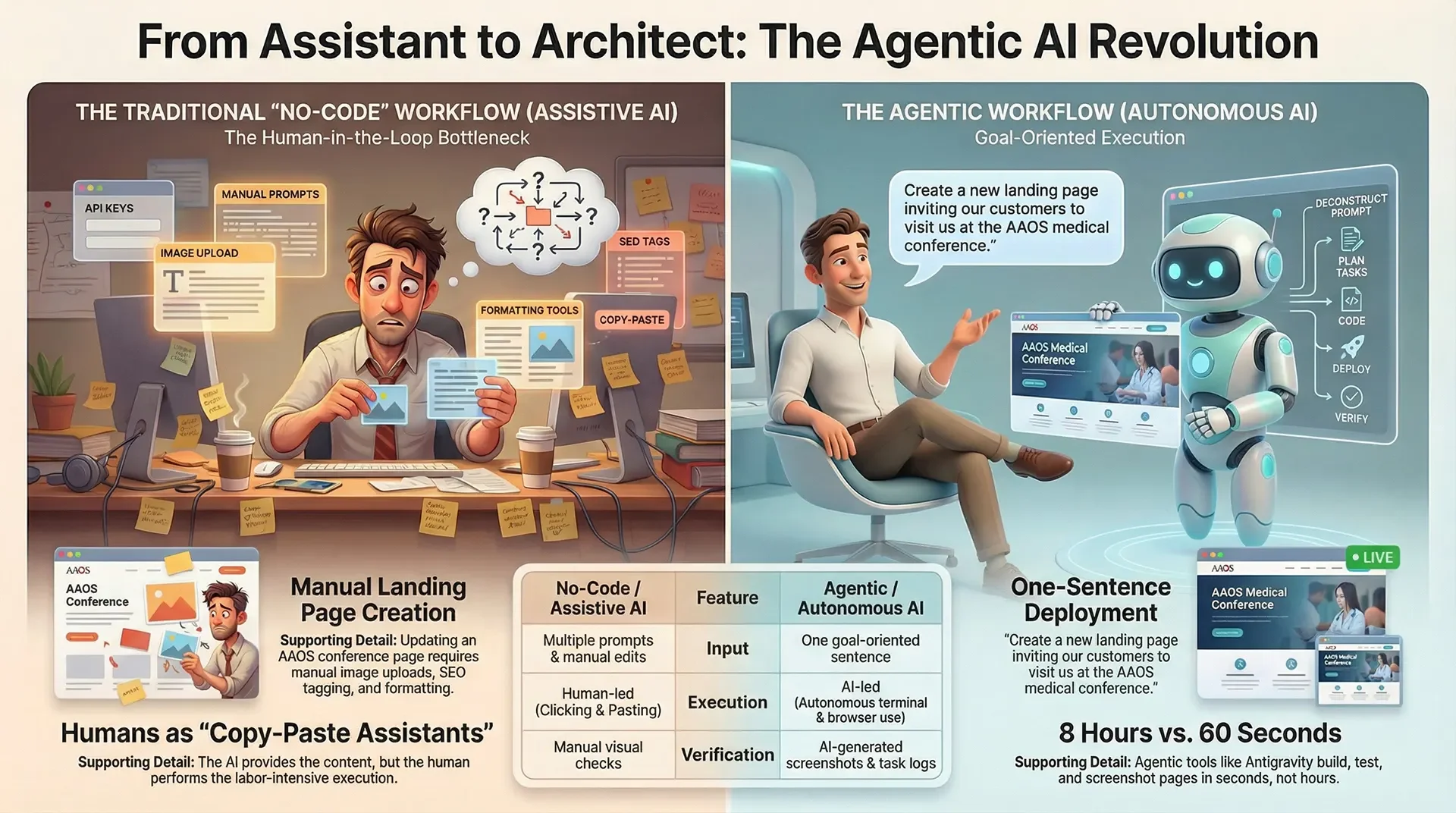
We're redesigning Ghost Medical's website, something we do at roughly twice the frequency of most companies, because our clients need us to be on the cutting edge of delivering dynamic media over the internet. We have to be our own guinea pigs first. If we haven't built it, broken it, fixed it, and understood exactly how it works, we have no business charging a client to build it for them.
Before you can migrate a website properly, step one is documenting everything your existing site touches and everything that touches it. Ghost Medical has been producing and distributing video content since 1994. Our 199-video YouTube library is just a tiny slice of our company's publicly visible story. The full picture spans YouTube, Vimeo, PubMed, NIH, medical education platforms, hospital networks, and dozens of other media-serving platforms that have been embedding, linking to, and distributing our content for decades. Hundreds of thousands of external references exist out there. If we fail to get all those outgoing links and incoming backlinks correctly reconnected after a migration, we destroy the domain authority it took us over 30 years to build. Search engines don't give that back easily or quickly. It has to be done right, and doing it right means documenting every single one of them before we touch anything.
That is a genuinely large and tedious job. I blocked off an entire eight-hour day for it and expected it to be a slog.
I started the way I normally do these days: I asked Grok if it knew a fast way to pull all the metadata I needed. It returned three commercially available tools. I tried the first one. It worked perfectly, pulling everything into a clean CSV. Unfortunately it now sells SaaS like drug dealers. The first 10 records are free, but processing the remaining references costs $9.99 a month. I hate subscription models for something I need once every four years. But still better than spending a day in Postman connecting and testing API structure.
It was then that I remembered a new app I'd been toying around with recently. An app called Antigravity from Google.
Before pointing any new tool at Ghost Medical's actual channels, I always test on something I can afford to break. My personal YouTube channel, @verdantride, is an efoil and surfing channel. It's got 152 videos of me enjoying my favorite summer pastime and a genuinely impressive volume of angry comments from strangers deeply concerned that I don't wear a helmet when I ride. Pretty low stakes if something goes sideways. It is a perfect sandbox.
I want to be clear before I describe what happened next, because I can already hear the skeptical technical reader thinking: "You're impressed by a web scraper?" Fair challenge. Let me explain why this was not that.
If I were going to automate this metadata collection myself, the way I'd normally approach it is through an API. YouTube has a Data API. Vimeo has one. Most serious platforms do. The standard workflow would be to authenticate against each API, map the fields I need, write the logic to handle pagination and rate limits, format and normalize the output across platforms so everything lands in the same schema, and then stitch it all together into something useful. It's not hard work exactly, but it is a half-day of focused technical effort per platform, before you've pulled a single record. Multiply that across YouTube, Vimeo, PubMed, NIH, and the rest, and you've filled your eight hours before you've even touched the backlink audit.
That's the baseline. That's what "doing it the right way" actually costs in time and effort. Keep that number in mind.
I opened Antigravity, a relatively new AI tool from Google that is notably unfriendly compared to ChatGPT or Claude. It doesn't make conversation. It doesn't ask clarifying questions or tell you how great your request is. You describe what you need and it gets to work. I've been using it for about three weeks and it has yet to fail me on anything, including things that seemed like they should be impossible.
"Can you build me an app that can quickly export all my metadata for videos in my YouTube channel @verdantride?"
It thought quietly for about 15 seconds. Said nothing. Wrote a bunch of Python in the background that I didn't look at and didn't need to. Then a new Chrome window appeared titled "YouTube Meta Exporter," with my channel handle already filled in and a single button that read "Extract Data."
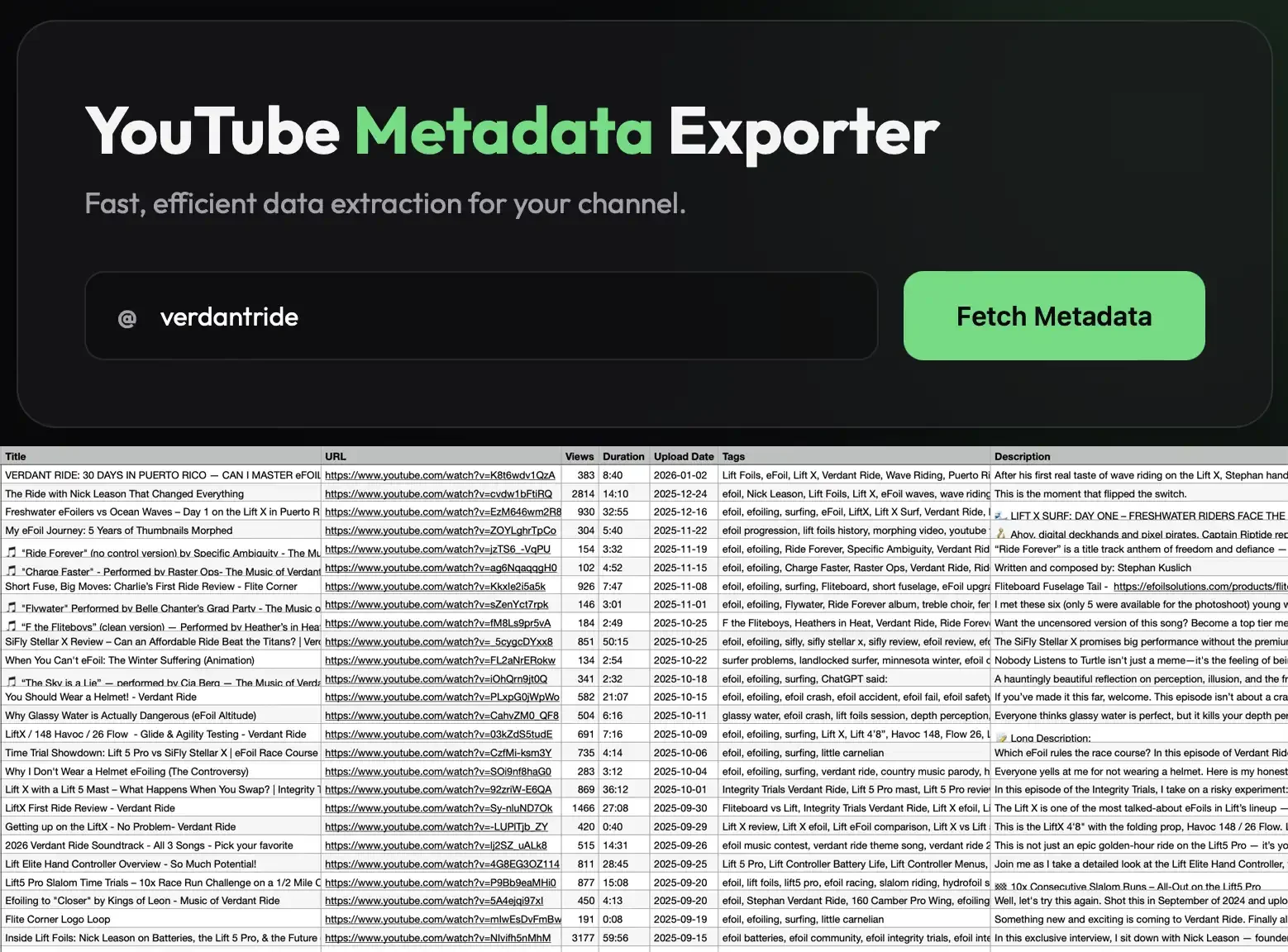
I clicked it.
Apple Numbers opened with 152 perfectly formatted rows: every video ID, URL, publish date, tag, description, view count, and thumbnail link. Cleaner and more organized than anything I would have produced manually after a full morning of API work.
Here is the part that actually matters. The @verdantride test was never the job. It was the proof of concept. So I typed one more sentence, asking Antigravity to expand the app to cover every platform our content lives on, pull the full list of outgoing and incoming links, cross-reference the list against high-value and toxic backlinks in SEMrush, and then run it on Ghost Medical's actual library. What I was describing was the thing I'd blocked the entire day for. Multiple platforms, decades of content, a full link audit.
Antigravity didn't flinch. It expanded the app, extended the authentication to each platform, normalized the data schema across all of them, and ran the whole thing. The data collection took hours but the my effort and time, the human cost to this project was in an out in less than one minute.
What would have been 8 hours or boring configurations and testing in Postman and the back and forth of establishing API tokens was perfectly executed at 47,900% higher efficiency. I sat there for a moment not quite knowing what just happened, or how to process something that had seemed completely impossible when I woke up this morning. That's not a scraper story. That's an effort-to-scope story. The scope multiplied by ten. The effort stayed at zero. I reclaimed a whole day and while the Antigravity hunted down all of our content, flagged issues, sequestered links to keep from toxic sources and deadens, I got too spend my time developing the look and the feel of our next website and that's something I love to do.

Here's where I want to be direct, because the hype cycle around agentic AI is already starting to outpace the reality. That's dangerous for anyone deploying it in environments where mistakes have real-world, mission-critical consequences.
Traditional AI has a built-in safety net: you. Every output passes through a human before it touches anything real. If it gives you a bad answer, you catch it, you throw out the draft, you ask again. It never had access to your live systems in the first place. The worst case was wasted time.
Agentic AI removes that buffer entirely. An agent that can execute tasks can execute them wrong, at machine speed, across hundreds of assets, before you've had time to register that something is off. Point one of these tools at your live website with an ambiguous instruction and it might rewrite metadata across your entire content library before you can stop it. Ask it to clean up a file structure and it might delete things it decided were redundant. These tools navigate and act so quickly that by the time you realize something went sideways, it has already clicked through four confirmation dialogs to finish the job.
The smart way to think about agentic AI is similar to how you'd handle a new employee. Do you give a new hire access to all your sensitive data, carte blanche use of the AMEX Platinum, and the combination to the company vault with no oversight? Agentic AI is exactly that. A new hire we're going to observe and audit until we're completely convinced it isn't about to fall for a phishing scam or wire our money to a Nigerian prince.
Right now we are testing agentic AI carefully, in controlled environments, on work we can afford to redo. We want to know if it can reliably build and maintain a website in a fraction of the time, potentially compressing what would be a 3–6 month redesign project into 4–6 weeks. The early signs are promising. But promising is not the same as proven, and in our world — medical device marketing, pharma visualization, clinical training content — proven is the only standard that matters.
There's a second layer of risk that doesn't get discussed enough, especially in our space: security. Intellectual property. Proprietary clinical data. Device specifications that haven't cleared disclosure review. When an AI agent is writing and executing code on your systems, you need to know what every line of that code actually does. Not generally. Specifically.
We are reading every script Antigravity produces before we let it run on anything connected to real work. Not because we expect it to be malicious, but because trust has to be earned through verification, not assumed. So far the code looks clean. More than clean. It's efficient and well-documented, which means our developers can get inside it, understand the logic, make adjustments, and run proper hardening tests. We were looking for shenanigans and skullduggery and we haven't found any. But we keep looking.
"It didn't delete my surfing channel" is a very long way from "ready for a client's production environment." I don't know yet exactly how long it will take to generate enough evidence to trust it at that level. What I know is that the evidence has to come first. I'm testing it on my own skin only. My own channels, my own website, my own data. A lot has to go right, consistently, before I risk it on anyone else's operation, let alone clients in medical device or pharma where the stakes are regulatory, legal, and clinical.
We'll expand what we trust it to do as it earns that trust. Not before.
If you're in medtech, pharmaceutical manufacturing, a treatment center, or any healthcare-adjacent organization wondering what agentic AI could actually do for your operation — the honest answer right now is: a lot, eventually, with the right guardrails.
The tools we already build for clients — including regulatory-language-aware content assistants, competitive intelligence bots, RFP automation, and clinical study summarization tools — are all built on Custom GPTs and OpenAI Assistants. They work. They're proven. They're already saving our clients significant time on work that used to require dedicated headcount.
Agentic AI is the next layer. It's what happens when those intelligent tools stop handing you outputs to apply manually and start applying them directly — navigating your systems, updating your content, executing workflows end to end, and delivering finished results instead of drafts. The compression in time and cost that implies is genuinely significant. We're talking about the difference between AI as a powerful assistant and AI as a capable team member.
But it requires implementation done by people who understand both the technology and the stakes. In a space where regulatory compliance, clinical accuracy, and SEO integrity are non-negotiable, "move fast and break things" is not a strategy. Methodical testing, clear scope boundaries, and proper sandboxing are the difference between a tool that transforms your operation and one that quietly corrupts it.
The days of being your AI's copy-paste assistant are numbered. The question isn't whether agentic AI will change how your team operates. It's whether you'll have the right infrastructure and expertise in place when it does — or whether you'll be sorting out the damage from someone who moved too fast.
We've spent years building custom AI tools for medical device manufacturers, pharmaceutical companies, hospitals, and research institutions. Not generic tools repurposed for healthcare — but systems built from the ground up around your regulatory language, your products, your workflows, and your stakes.
If you want to talk about where AI automation can genuinely transform your operations, and where it needs guardrails before you point it at anything live, we could geek out on this all day long.
Contact Ghost Medical →🎙️ Related Podcast
Agentic AI & The SaaS Apocalypse
The Deep Dive Podcast • AI Deep Dive
Share this article

Ghost Medical is an award-winning leader in medical visualization, specializing in custom medical animation, medical marketing services, and surgical training solutions. We provide a comprehensive range of digital services designed to elevate medical marketing, enhance patient communication, and streamline staff training. With a team of highly skilled professionals and deep expertise in biomedical processes, we ensure precise and impactful representations of your device, product, or procedure through 3D animations, medical illustration, and other dynamic media formats. Contact Ghost Medical today to discover how we can help you train surgeons, boost medical device sales, or effectively communicate your pharmaceutical innovations.
Start a Project


